Canada’s World Cup dreams ended Saturday at Houston Stadium.
The game against Morocco was there for the taking. Canada dominated the first half, and Tani Oluwaseyi had a great chance to open the scoring, but Moroccan goalkeeper Yassine Bounou made a great save. Jonathan David was open too. You could also wonder: What if Oluwaseyi passed the ball to David?
Canada couldn’t capitalize on their set pieces, and their attack simply wasn’t good enough. Morocco made them pay with two goals from Azzedine Ounanai and another from Soufiane Rahimi.
A World Cup to be proud of
Prior to the 2026 World Cup, Canada never won a game at the big tournament, let alone get a single point.
They achieved those and also won their first knockout game, making it to the Round of 16 for the very first time. If you told any Canadian soccer fan that before the World Cup, they’d say they would have taken it.
This Canadian team has a brotherhood vibe. That was put in place by former head coach John Herdman. When Herdman left in 2023, Canada needed someone to push them even further and keep that tight-knit bond. It turns out that the man was an American, Jesse Marsch, born and raised in Racine, Wisconsin.
Marsch embraced coaching Canada and the players, his staff and the country embraced him. He brought energy and intensity with his 4-4-2 formation and “Maplepressing” style of soccer. Marsch is never afraid to show off his emotions and tell his players they need to be better.
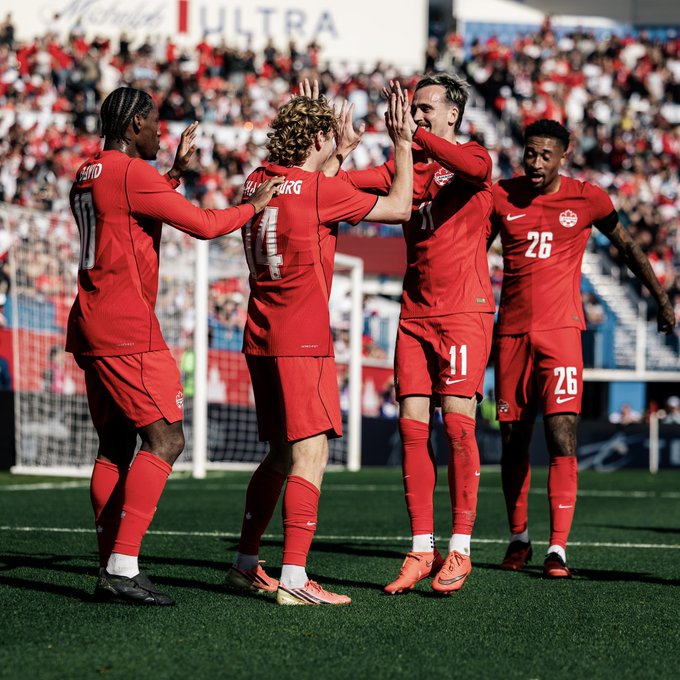
Fans will also never forget Cyle Larin scoring the first Canadian goal in a men’s World Cup on home soil in Toronto against Bosnia and Herzegovina. They will never forget David’s hat trick in Vancouver in the 6-0 drubbing of Qatar and Marsch’s iconic sideline dance. Canadian fans will also never forget Stephen Eustaquio’s stoppage-time winner against South Africa in the Round of 32.
From coast to coast, Canadians were decked out in red for their soccer teams. Fans marched and cheered in the streets of Vancouver and Toronto and watched in homes, pubs, fan festivals and other viewing parties across the country. Even people who normally don’t watch soccer were dialled in. Social media posts about the Canadian men’s team and TV viewership skyrocketed. Canada definitely gained new soccer fans.
Players such as Eustaquio, Luc de Fougerolles, Derek Cornelius, Promise David, Ali Ahmed and Maxime Crépeau became names talked about all across the country. Fans also rallied around Ismael Koné after his devastating leg injury against Qatar.
The players have a lot to be proud of. Nine years ago, this federation was ranked 120th in the world. In 2012, they lost 8-1 to Honduras.
A lot has changed since then. Several players are playing for top clubs in Europe, and some could very well be on the verge of a big move. Marsch has done an excellent job in finding new talent for this squad. Moise Bombito was playing community college soccer five years ago and is now Canada’s top defender. De Fougerolles, Promise David and Niko Sigur were convinced by Marsch to switch allegiances to Canada.
This is the golden generation of the Canadian men’s national team, and they are in their prime. At the 2026 World Cup on home soil (until the knockout round), they captured the hearts of millions of Canadians. There is so much to be proud of.
“What a privilege our fans have to follow a team like this that goes after the game like this and doesn’t play defensive and shows they can be better,” said Marsch after the loss to Morocco. “I’d rather be us than them. As good as Morocco are, I’d rather be us. I couldn’t be happier.”
What ifs
Of course, there are a lot of things that could’ve gone differently for Canada at this World Cup. We mentioned the Oluwaseyi chance against Morocco, but the biggest what-if is the injuries.
The big one surrounds Alphonso Davies. Canada’s best player has been dealing with injuries since the 2025 CONCACAF Nations League. He was dealing with another hamstring injury sustained late last season with Bayern Munich. (After they rushed him back.) Marsch was cautious with his star player, and he only played 15 minutes all tournament. That was against South Africa.
Davies did not play against Bosnia and Qatar and was used as a “decoy” against Switzerland, but did not play. Apparently, he was not ready to go against Morocco.
“His hamstring didn’t feel right,” said Marsch on Davies after the Morocco game. “We were hoping by the time this morning he woke up that he would feel better…. It killed him more than anyone. But I think it was the right decision to preserve him and get him fully healthy for his career.”
Davies confirmed to the media that he did not want to take any risks.
What if Davies was fully healthy? When he is, he is one of the best left-backs in the world. Perhaps a healthy Davies would’ve made a big difference against Bosnia, Switzerland and Morocco. Maybe Canada would’ve won Group B with a healthy Davies. His speed and passing would’ve set up more scoring chances.
Several other players dealt with injuries prior to and during the tournament. You can’t help but wonder what would’ve happened if Canada had both Koné and Eustaquio healthy for the game against Switzerland. Or what if Bombito was at 100% for the whole tournament? How far would a fully healthy Canada have gone at this World Cup? We’ll never know.
Plus, dual national Marcelo Flores tore his ACL before the World Cup. What if he was fit? Canada needed some more attacking creativity.
Aside from injuries, a big issue was finishing. Jonathan David had a poor World Cup aside from the hat trick against Qatar. What if he scored against Bosnia and/or Switzerland? What about against South Africa and Morocco? Imagine if Derek Cornelius scored one of his two headers late in the game against the Swiss.
You also can’t help but wonder what if Canada won Group B and got to stay in Vancouver. They would’ve faced Algeria in the Round of 32 at BC Place, and if they won that game, Colombia in the Round of 16. Maybe they would’ve beaten Colombia, or maybe not.
The future
But despite all that, there is a lot to be optimistic about surrounding the Canadian men’s program.
As mentioned, a lot of the core is still in its prime. As it stands, Canada ranks 30th in the FIFA rankings. Not bad for a country that was once ranked 120th.
The World Cup definitely has increased the interest in soccer. 50% of young Canadians play soccer, and the World Cup will definitely increase that. Fan engagement will increase too. Perhaps people who became soccer fans in this World Cup have now become lifelong fans of Canada’s men’s team. Maybe they will start supporting a Premier League or European club, or better yet, their local MLS, CPL, NSL or League One club. (Side note: Hopefully, a big legacy of the World Cup in Vancouver is keeping the Whitecaps there and building a new stadium.)
For Canada Soccer, they now look ahead to the 2030 World Cup in Spain, Portugal and Morocco. Actually, there are two competitive tournaments around the corner. There is the 2026-27 CONCACAF Nations League and the 2027 CONCACAF Gold Cup. Canada has a chance to win not just one, but two trophies. They haven’t won one since they won the Gold Cup in 2000.
Canada needs to keep doing what has been working. That means continuing to discover and develop young talent. Maybe there is a player out there who is unknown and will be playing for Canada at the 2030 World Cup. After all, no one knew about Bombito back in 2022. Whether that is in the MLS, MLS Next Pro, CPL, League One, USports or the NCAA or European academies, Canada needs to keep finding and developing talent.
Canada has several players 25 and under who could very well feature in 2030. That includes de Fougerolles, who is just 20. There is also Promise David, goalkeeper Owen Goodman, Jayden Nelson, Nathan Saliba, Sigur and Koné .
Several Canadians who didn’t get called up for the World Cup have a chance for 2030. That includes Ralph Priso of the Vancouver Whitecaps, who brings versatility as a centre-back and midfielder. Other young names include Jeevan Badwal, Jamie Knight-Lebel, Jacen Russell-Rowe, Daniel Jebbison and Aribim Pepple. And of course, there are names that we don’t know about yet.
The 2026 World Cup should be the springboard for more Canadian soccer success in the long-term future. Canada proved it can go toe to toe with the world’s best teams. But there is still so much to work on. One thing is for sure: Canada is a soccer country.
Discover more from A51
Subscribe to get the latest posts sent to your email.